


We kept pushing east along the Central Route, deeper into Afghanistan’s rugged heartland — and with every kilometer, the world around us grew wilder, rawer, and more remote. Roads were no more roads but rock-strewn trails with potholes as big as half of our car. But the landscapes… they made up for every bump and jolt. Colorful hills and mountains, silent valleys, mud-walled villages that seemed frozen in time. Houses sculpted from stone, straw, and clay. More donkeys than cars and more dust than direction and the adventure's still growing.

The central Route plan – part II: We didn’t even come half way and it’s been intense.

Made it to the Jam Minaret. Tucked deep into the valleys of Ghor province, this 65-meter brick tower rises out of nowhere, surrounded by raw Afghan mountain landscapes that feel completely untouched by time. It seemed like it was protected by the Talibans, but they were actually just hanging around there. Had to pay an entrance fee which was quite expensive €10.- just to have a look from close.

Standing in front of the Minaret, built in 1194 by the Ghurid dynasty, you feel small.
Getting to the Minaret of Jam was an adventure in itself. After hours of crawling along roads that could barely be called roads, very rocky passes, steep drop-offs, washed-out tracks. We looked at each other and were asking ourselves: are we actually going to make it? At some points we thought no. And we've been quite stressed about having no more shock absurbers and no swaybar. But that’s part of the thrill: the harder the way, the greater the reward. As we got close to the minaret we realize that was actually the closed we could get since the road was washed away. We got out of the car and from far the minaret looked already stunning.

A UNESCO WORLD HARITAGE SITE
The Minaret of Jam was added to the UNESCO World Heritage List in 2002 as one of the finest examples of Islamic brick architecture in the world. At the same time, it was immediately placed on the List of World Heritage in Danger since the site is extremely vulnerable. It stands on the banks of two rivers, which regularly flood and erode the soil around its base. Also earthquakes, harsh winters, and years of neglect due to Afghanistan’s instability, it became clear how fragile this monument is. UNESCO and international teams have carried out surveys and emergency stabilization, but long-term conservation is difficult in such a remote and politically sensitive area.
Standing there and knowing all this made our experience even more powerful. Hopefully it will remain, The Minaret of Jam is such a beautiful relic.


Zipline was run by Talibans. Had to pay a little amount to the guys to pull us over.


Halfway from Herat to Kabul, everything shifted — once again, not as expected, but in the best possible way.
The raw beauty of Afghanistan’s landscapes kept leaving us speechless — endless mountains, desert plains, and villages that felt suspended in time. We tried to adapt to the rhythm of this place: its customs, its silence, its intensity. It felt like driving through a time tunnel.
Our initial nervousness faded with every conversation. Locals — including members of the Taliban — were curious, not hostile. Where are you from? How did you drive here from Switzerland? Why Afghanistan? We were asked these questions daily, and every answer led to long, respectful exchanges. What a release and change of mindset it was. Once again, we were reminded just how powerful and one-sided the influence of Western media can be.

Driving the central route of Afghanistan meant following the river through endless, sweeping landscapes …


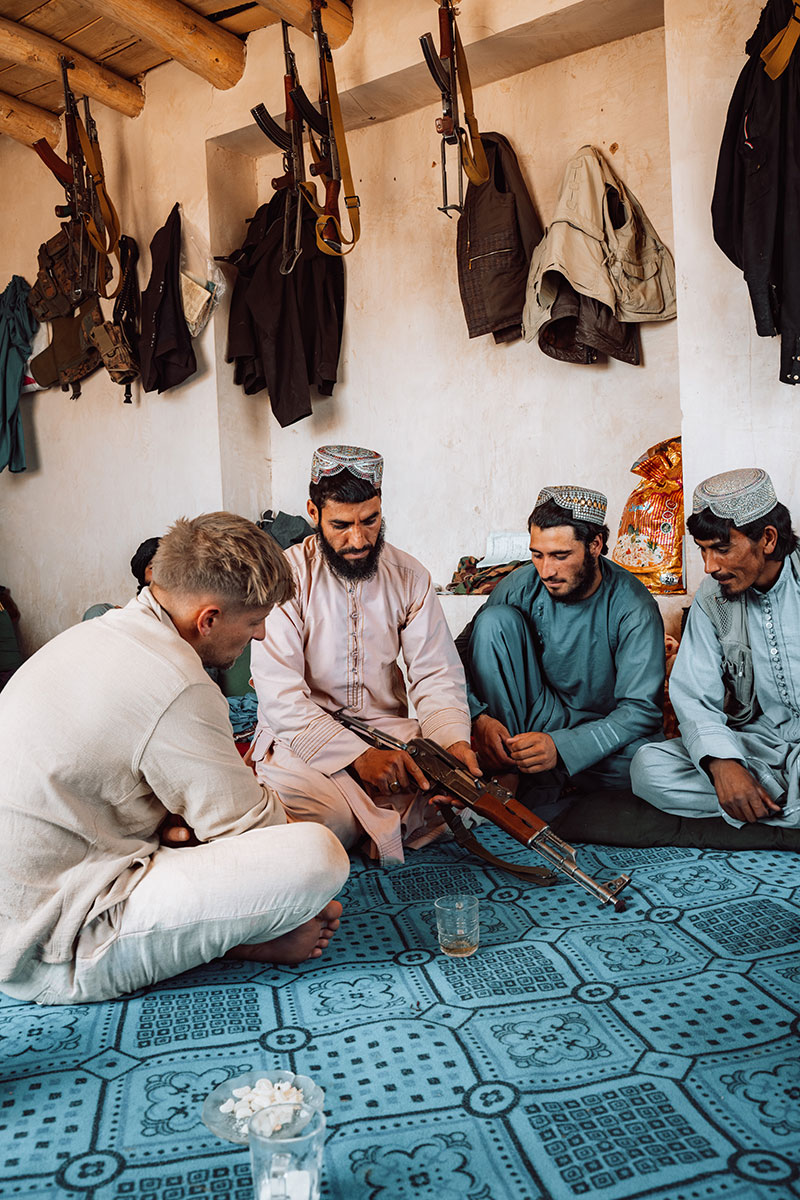
MORE TEA WITH TALIBANS AND AK47
At another dusty roadside checkpoint we were invited for some tea with another group of Taliban fighters. We got somehow used to it. Some herbal tea with tons of sugar and some bread.
AK-47 were hanging all around us. One of them picked up an AK-47 and gave a hands-on demonstration and showed us how the weapon functioned and how to hold it. Watching, we felt the absurd contrast between the warmth of being offered food and the quiet and then playing around with a rifle.




A quick selfie with our friend Nathan, in the background some rainbow colored mountains.


Our initial nervousness faded with every conversation. Locals, including members of the Taliban, were curious, not hostile. Where are you from? How did you drive here from Switzerland? Why Afghanistan? We were asked these questions daily, and every answer led to some nice, respectful exchanges. What a release and change of mindset it was. Once again, we were reminded just how powerful and one-sided the influence of Western media can be.
Like most people, our imagination had already been shaped by the headlines. The media had painted a picture of fear, danger, and chaos. Add to that the countless warnings we heard along the way, "Don’t go, it’s too dangerous," "Be careful at every step." This we had in the back of our minds until we left the country.
We never expected to feel the kind of respect we felt here. Respect for the resilience of the people, for the way life continues despite every challenge, for the mountains and landscapes that humble you at every turn. It wasn’t easy, and it wasn’t always comfortable.


